
Searching Lincoln County Civil Dockets
Wisconsin Circuit Court Access is free and public. WCCA indexes Lincoln County Circuit Court. An exact case number is your best opening move. Name searches work too, and a business-name field helps when an entity is a party. Pick Lincoln County and narrow by case type. Before opening a result, check the caption. The filing date, branch, status, and case type should match what you already know.
For documents and verification, the Lincoln County Clerk of Circuit Court is the channel. The civil and jury clerk handles administrative questions by phone. A public CCAP workstation sits in the courthouse. Copy requests can go in person or by mail. Ask about page count, certification, redaction, delivery, and payment up front. WCCA never displays or sells the underlying eFiled documents.
- Open WCCA and select Lincoln County.
- Enter the full civil case number, or use a party or business name with a case type.
- Match the caption, filing date, branch, case code, and status.
- Read filings, service, answers, motions, settings, judgment, and satisfaction entries in date order.
- Give the clerk the case number and docket-entry description when requesting a document.
Lincoln County Civil Docket Codes
The prefix on a case matters. It keeps a Lincoln County civil docket search pointed at the right procedure. CV marks general civil, while SC is small claims. Family and paternity matters run under FA and PA. Probate, guardianship, and similar matters use other codes and may pass through the Register in Probate. The type shapes what the public can see and which clerk should get your question.
- CV
- A general civil Circuit Court case.
- SC
- A small-claims case governed by the streamlined Chapter 799 process.
- FA
- A family case with access limits that can differ by filing.
- PA
- A paternity case, kept distinct from general civil.
- Return date
- The initial small-claims date set by the clerk, generally not a hearing or trial.
A code routes a search; it never tells the whole story of a dispute. Liens, foreign judgments, probate-related records, and juvenile civil categories can carry separate rules. If the prefix or access level is unclear, hand the case number to the clerk instead of trusting a broad WCCA name match.
Inside a Lincoln County Civil Docket
Open a public Lincoln County civil docket and you may see the case type and number, filing date, branch and judge, parties, attorneys, claim category, service, answer, motions, return or trial dates, judgment, costs, satisfaction, appeal, and cross-references. A "judgment entered" line counts as a docket event. It still does not make the index a signed or certified judgment.
| Case number | A Wisconsin identifier carrying a code such as CV or SC. |
|---|---|
| Public parties | The caption and party roles shown under the applicable access rules. |
| Filings | Dated descriptions of complaints, answers, motions, orders, or other items. |
| Settings | Return dates, motion hearings, pretrial events, or trials, depending on case type. |
| Outcome | Judgment, dismissal, costs, satisfaction, appeal, or other disposition entries. |
Getting the actual filing takes two things. You need its date and its description. The statewide circuit fee chart prices an ordinary clerk copy at $1.25 per page. A certified copy runs $5 for certification plus $1.25 per page. The clerk must confirm the item is public, on hand, and eligible for certification.
Lincoln Civil Docket Return Dates
Lincoln County Local Rule 2 clears up a calendar mistake many people make. The initial small-claims return date is not a hearing. The clerk sets it. Parties generally do not need to show up. A defendant who contests the claim must file a written answer instead. Only then does the clerk schedule the trial. No answer can mean a default judgment. It appears on the docket rather than vanishing from search results.
That distinction changes how a WCCA entry reads. A return date promises no testimony that day. The trial is a later, separate event. Evictions get the first available trial under the local rule. An amended money-damages complaint must be filed within 21 days after an eviction judgment. The current notice and the clerk's scheduling record govern the real obligation.
Check the newest Lincoln County civil docket entries first. Do not trust a date printed on older small-claims paperwork.
Civil Case Types on the Docket
Civil work in Lincoln County is not one stream. General civil and small claims are the common entry points, while family, paternity, liens, foreign judgments, probate-related records, and juvenile civil categories follow their own codes and access rules. Knowing the type gets you to the right office and helps you read the next court date correctly.
- CV: general civil disputes and related motions or judgments.
- SC: small claims, including the local return-date and written-answer process.
- FA and PA: family and paternity matters with filing-specific access limits.
- Liens and foreign judgments: records that can include docketing and satisfaction events.
- Probate and juvenile civil categories: matters requiring a separate office and privacy check.
Need the right desk? The civil and jury clerk is Amy Trantow at (715) 536-0303. Family clerk Alissa Zajackowski sits at (715) 536-0323. Two lines, two case-type worlds, one Lincoln County Circuit Court.
Lincoln Civil Docket Probate Boundaries
The Register in Probate is a record-keeping office inside the circuit system. It is not an appeals court. Its docket territory covers estates, guardianships, adoptions, terminations, juvenile matters, and mental-commitment procedure. Access swings sharply by category. Lincoln County treats mental-commitment files and proceedings as closed to the public. Juvenile-related records require a confidentiality check before anything is disclosed. The official Register in Probate page lists those record groups. It also explains the office's role. That helps separate a general civil docket search from a probate or restricted matter.
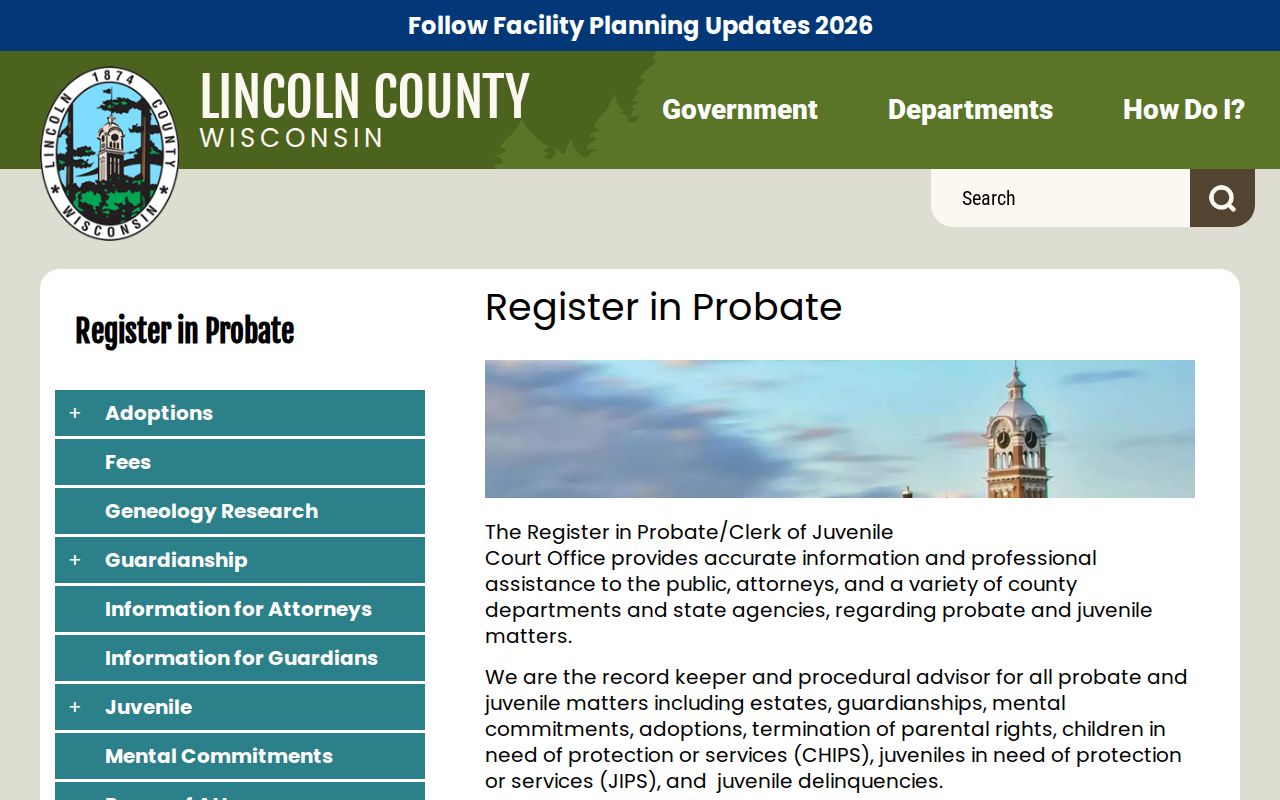
That office hands out forms, schedules, and general procedural information. It cannot give legal advice or tell anyone what to file. And when WCCA shows nothing for a probate, juvenile, or commitment matter, treat it as an access question rather than proof that no record exists.
Civil Docket Settings and Hearings
WCCA settings pull a lot together at once. County, date, time, and location sit alongside the activity, case number, caption, court official, and attorneys. Those fields appear only when filled in. A Lincoln County civil docket may label a return date, a motion hearing, a pretrial, a status conference, or a trial. Each event does different work. When you call the clerk about a date, copy the activity label word for word.
The clerk posts no separate public daily calendar for Lincoln County. WCCA is the searchable public settings layer. The branch or clerk is the fallback when you need a hearing confirmed. A docket marked reset, continued, or adjourned deserves a second look. Compare the newest dates on the entry. If two settings sit side by side, ask which one controls. A reset is not a dismissal. For the broader settings path, see the Lincoln County court dates resource.
Scheduling orders can bury deadlines that never look like courtroom events. Read the docket entry's description first. When the exact terms matter, request the order itself. Public eFiling has not turned those documents into a general online viewer.
Lincoln Civil Docket Fee Stack
The county small-claims page lists several fees effective April 26, 2024. Each one pays for a different act. Adding every row together would be wrong. A filing can involve a summons and complaint, service, a counterclaim, or a jury demand, depending on what a party actually submits, while copy and docketing charges arise later when requested or applicable.
| Small-claims item | Listed amount |
|---|---|
| Summons and complaint | $94.50 |
| Service by mail | $2 per defendant |
| Third-party complaint | $117.50 |
| Crossclaim or counterclaim over $10,000 | $125.50 |
| Jury demand | $89 |
| Docketing, writ, execution, or satisfaction where applicable | $5 each |
Copies run $1.25 per page. The WCCA docket search stays free. Confirm the current fee and payment instructions with the clerk before you file or order court records. Keep in mind that a docket entry will not show whether a filing fee was calculated correctly for a new submission.
Lincoln Civil Docket Flow
The Wisconsin judiciary's 2024 report puts the Lincoln County civil docket in plain numbers: 928 incoming and 907 outgoing civil events. That leaves 232 matters pending at year end. The clearance ratio was 98 percent. Inside the total sat 861 openings, 20 reopenings, 41 transfers in, and six reactivations. These are administrative events. They are not a count of unique parties or a measure of who prevailed.
Component clearance ratios varied: 97 percent for civil other, 116 percent for divorce, 115 percent for paternity, and 105 percent for other family. Small claims split by type. Contested matters cleared at 82 percent, and uncontested ones at 96 percent. Anything above 100 percent means more matters left the docket than arrived. A ratio that high often reflects older pending or reactivated work finally clearing out. It is not a win rate.
Lincoln Civil Docket Access Rules
Wisconsin's public-records policy leans toward access. Even so, specific confidentiality statutes, redaction duties, and court orders still bind a Lincoln County civil docket. Public WCCA can omit protected identifying data. It also does not provide the filed documents. Family, paternity, juvenile, commitment, sealed, and other confidential filings may face tighter limits than general civil or small claims.
Key rules:
Wis. Stat. §19.31 states the policy favoring public access.
Wis. Stat. §59.20(3) addresses clerk custody and inspection subject to law.
Wis. Stat. §801.20 identifies confidential court filings.
The official probate contact page shows the specialized inquiry route. It offers an office contact channel, not a public docket database.
When you call, ask whether the public portion can be inspected, whether a redacted version exists, and what copy form the office can supply. If access is denied, request the governing statute, rule, or order. Ask about partial production too. No courthouse terminal overrides a seal. The same goes for any confidentiality rule.